Containerized fuel station sourcing
Containerized Fuel Station Manufacturer in China
Sino Supply Works is a China Industrial Solution Partner helping overseas buyers define and source customized containerized fuel station projects. We coordinate the technical and commercial scope with suitable Chinese manufacturing resources before quotation and production.
- Customized capacity based on project demand
- Single, two-compartment, and three-compartment options
- Diesel, gasoline/petrol, and separate fuel-storage configurations
- Double-nozzle and triple-nozzle dispenser options
Tell us your fuel capacity, fuel type, compartment requirements, voltage, application, and destination country. We will help identify the missing details for a supplier-ready RFQ.
Start Configuration ReviewRFQ scope
China RFQ details to clarify before supplier quotation
Send the closest details you already have. Sino Supply Works helps organize missing RFQ information before suitable Chinese supplier resources quote.
Containerized or skid-mounted design
Pump and dispenser requirements
Safety accessories
Power supply
Destination and compliance requirements
Buyer requirements
When fixed fuel infrastructure does not fit the project
Containerized fuel stations are used when an industrial buyer needs controlled fuel storage and dispensing but a conventional permanent station is impractical, too slow to establish, or unsuitable for the operating site.
Remote and temporary sites
Mining, construction, energy, and infrastructure projects may need dependable on-site fueling where public fuel access is limited.
Fleet and distribution control
Fleet operators and fuel distributors may need controlled dispensing, separate products, defined capacity splits, and clearer inventory visibility.
Project-specific configuration
Capacity, compartments, dispenser, voltage, climate, site layout, destination rules, and logistics constraints should be reviewed before equipment selection.
Comparable supplier quotations
Requirements, components, tests, documents, exclusions, spare parts, and support scope should be clarified so suppliers quote the same project basis.
Solution overview
Practical project coordination—not a generic factory claim
A containerized fuel station combines storage, transfer, dispensing, metering, electrical control, monitoring, and safety provisions within or around a transportable steel enclosure.
Sino Supply Works does not present itself as one factory that owns every manufacturing process. We help buyers prepare a supplier-ready RFQ, coordinate with suitable manufacturing resources, clarify technical and commercial scope, follow production questions, arrange agreed inspection activities, prepare for export, and maintain practical communication after delivery.
Customized solution coordination
Tank capacity, fuel type, compartment split, pump, filter, meter, hose, nozzle, voltage, controls, monitoring, documents, tests, packing, and support scope are reviewed together.
Engineering communication
Drawings, components, interfaces, inspection points, responsibilities, exclusions, and buyer approvals should be converted into an agreed scope before production.
Export coordination
Dimensions, weight, lifting, packing, loading, documents, destination port, unloading conditions, and shipment preparation can be coordinated before dispatch.
After-sales planning
Agreed spare parts, technical documents, remote guidance, operation support, and problem-solving assistance should be defined before the equipment ships.
Configuration
Compare the main decisions before requesting a quotation
These are project-review options, not universal standard equipment. Final feasibility and manufacturer scope must be confirmed against the complete RFQ.
| Configuration category | Options for project review | Main buyer decision |
|---|---|---|
| Capacity | 20,000L; 25,000L; 30,000L; 50,000L; other customized capacities subject to project review | Daily consumption, delivery interval, reserve requirement, site space, and transport constraints |
| Compartments | Single; two; three | Fuel assigned to each compartment and the required capacity split |
| Fuel | Diesel; gasoline/petrol; separate fuel-storage configurations | Fuel compatibility, destination requirements, and operating procedure |
| Dispenser | Double-nozzle dispenser; triple-nozzle dispenser; project-specific configurations | Fuel products, fueling positions, flow rate, metering, and controls |
| Optional systems | Solar energy storage system; leak detector; liquid level gauge | These are optional and subject to project review based on voltage, site conditions, components, fuel type, and buyer requirements |
Customization and internal configuration
Configured around the buyer's operating requirements
The internal arrangement is defined project by project. Capacity, fuel type, compartment quantity, pump and piping layout, dispenser requirements, optional systems, destination-country requirements and the final application all affect the configuration.
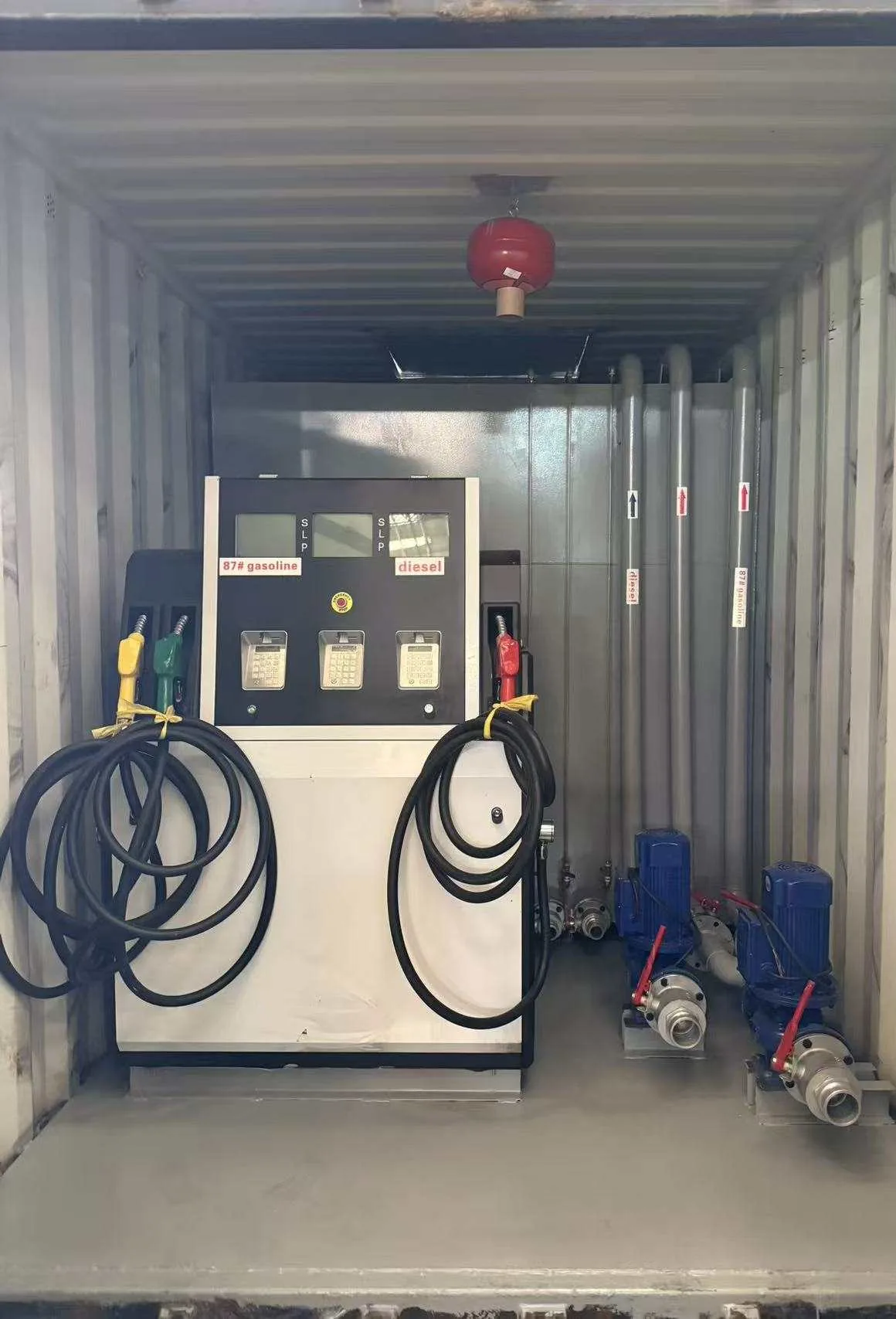
Configuration inputs
- Tank and container: required capacity and confirmed 20-foot or 40-foot arrangement
- Stored fuel: diesel, gasoline/petrol or separate fuel grades
- Compartments: single, two, three or another engineering-reviewed arrangement
- Delivery system: pumps, piping and dispenser channels selected for the project
- Site requirements: application, destination-country requirements and confirmed optional systems
Dispenser channel quantity does not automatically equal tank compartment quantity. Final technical details are confirmed from project information, not appearance alone.


Selected overseas project experience
Verified 30,000L three-compartment project
30,000L three-compartment containerized fuel station for a Caribbean market project. The privacy-safe walk-through focuses on the confirmed internal piping, valves and pump arrangement.
This is one customized project example, not a fixed standard model. Final specifications and equipment scope are confirmed for each buyer.
Tell us your required capacity, fuel type, compartment arrangement, dispenser configuration and destination country.
Container and configuration examples
Use confirmed project information to select the container and layout
Tanks up to and including 20,000L are generally installed in a 20-foot container. Tanks of 25,000L and above are generally installed in a 40-foot container. Capacities between 20,000L and 25,000L require engineering confirmation.

Generally up to and including 20,000L
The final usable capacity and internal layout depend on fuel type, compartments, equipment and engineering review.
Generally 25,000L and above
Tank capacity, compartment arrangement, pumps, piping, dispenser and optional systems are confirmed together.
Single, two or three compartments
Different compartments may store diesel, gasoline/petrol or separate fuel grades when confirmed by the project design.
Dispenser options
Double-nozzle, triple-nozzle and project-specific configurations
Dispenser configuration is selected according to the required fuels and operating workflow. A triple-nozzle dispenser has three dispensing channels; it does not by itself prove that the tank has three compartments.

Manufacturing and inspection follow-up
Review the agreed arrangement before shipment
Inspection follow-up can focus on the confirmed tank layout, pumps, pipework, dispenser channels, wiring, labels, testing points and project documentation.


Industrial applications
Project-specific fueling for industrial buyers
The operating environment determines the capacity, fuel-control, monitoring, maintenance, and logistics questions that must be included in the RFQ.
Mining
Fueling closer to haul trucks, excavators, generators, and other equipment, with consumption, filtration, climate, security, and fuel control reviewed.
Construction and infrastructure
Temporary fueling for vehicles, generators, and site equipment, with site access, power, civil works, project duration, and future relocation considered.
Remote sites
Industrial, energy, and infrastructure projects where delivery intervals, reserve capacity, climate, corrosion, monitoring, maintenance, and spare parts require planning.
Fleet fueling and distribution
On-site fueling or multi-product distribution where capacity split, dispenser arrangement, controlled access, and inventory visibility may be required.
Buyer risk reduction
Reduce sourcing risk with one accountable China project contact
Sourcing risk often comes from unclear assumptions, fragmented communication, and incomplete scope—not only from equipment price.
Requirement clarification
Capacity, fuel, compartments, dispenser, voltage, site conditions, documents, tests, and responsibilities are clarified before quotation.
Engineering communication
Drawings, components, interfaces, changes, open points, and buyer approvals are coordinated before production release.
Supplier and production coordination
Suitable resources, quotation assumptions, schedule questions, component confirmation, and unresolved technical points are followed against the agreed scope.
Quality inspection coordination
Inspection points, test expectations, documentation, photographs, and third-party inspection requirements can be coordinated before shipment.
Export preparation
Packing, dimensions, weight, lifting, loading, documents, destination port, and unloading requirements can be coordinated before dispatch.
Spare parts with shipment
Recommended spare parts can be supplied where included in the agreed spare-parts list and selected system scope.
Remote technical guidance
Agreed remote guidance, operation support, and problem-solving assistance can continue after delivery. No local installation team is claimed unless separately arranged.
Manufacturing and quality coordination
Make the agreed scope visible before production
Sino Supply Works coordinates the project. Fabrication is performed by the selected manufacturing resource according to the confirmed order scope.
Engineering and fabrication review
- Fuel compatibility, capacity, and compartment allocation
- Tank, enclosure, piping, pump, meter, hose, and dispenser layout
- Voltage, frequency, electrical controls, and optional systems
- Site conditions, destination requirements, drawings, manuals, and documents
Inspection and export preparation
- Material, component, drawing, dimensional, weld, and coating checks
- Tank, piping, dispenser, electrical, alarm, and emergency-stop checks when included
- Documentation, final visual condition, packing, and loading inspection
- Final dimensions, weight, lifting, handling, spare parts, and unloading confirmation
No certification, inspection, test, performance result, or report is claimed unless it is specifically verified and included in the project scope.
After-sales support
Prepare support before the equipment ships
After-sales requirements should be agreed before shipment so the buyer knows what documents, spare parts, and assistance are included.
- Spare parts supplied with shipment according to the agreed list
- Remote technical guidance
- Operation support
- Problem-solving assistance during installation and operation
Support is remote unless a different scope is specifically agreed. Buyers should retain drawings, manuals, component information, test records, spare-parts lists, and clear photographs or videos when requesting assistance.
RFQ
Tell us what your project requires
Provide the closest information available. Sino Supply Works will identify missing technical or commercial details and coordinate the next practical step with suitable manufacturing resources.
Buyer FAQ
Questions before preparing an RFQ
The answers below describe project-review possibilities. Final manufacturing scope is confirmed against the selected supplier and complete RFQ.
Can the tank be divided into two or three compartments?
Yes. Single, two-compartment, and three-compartment configurations can be reviewed. The fuel assigned to each compartment, required capacity split, piping, dispensing arrangement, and monitoring requirements must be confirmed during the technical review.
Can diesel and gasoline be stored separately?
A multi-compartment system can be reviewed for separate diesel and gasoline storage and dispensing. Compartments, piping, pumps, meters, hoses, nozzles, ventilation, electrical controls, and safety provisions must suit the specified fuels and destination requirements.
Which capacities can be customized?
Projects can be reviewed around 20,000L, 25,000L, 30,000L, 50,000L, or another project-specific capacity. These are reference configurations, not universal standard models, and final feasibility is confirmed against the complete RFQ.
Can double-nozzle or triple-nozzle dispensers be supplied?
Double-nozzle and triple-nozzle dispenser arrangements can be reviewed. The required fuel products, flow rate, hose length, metering, display, controls, and operating method should be included in the RFQ.
Can solar energy storage, leak detection, and liquid level gauges be added?
Solar energy storage systems, leak detectors, and liquid level gauges can be reviewed as project-specific options. Suitability depends on voltage, site conditions, communications availability, selected components, fuel type, and buyer requirements; these items are not assumed to be standard equipment.
What information is needed for quotation?
Provide the required capacity, fuel type, number of compartments, dispenser requirement, voltage and frequency, optional systems, project application, destination country, required delivery time, and any additional technical requirements available.
Are spare parts provided?
Recommended spare parts can be supplied with the shipment where they are included in the agreed project scope. The final spare-parts list depends on the selected pump, dispenser, controls, monitoring devices, and other system components.
Is remote technical support available after delivery?
The agreed after-sales scope can include remote technical guidance, operation support, and problem-solving assistance during installation and operation. Support is remote unless a different scope is specifically agreed; Sino Supply Works does not claim local installation teams where none have been arranged.
Related solutions
Continue with the most relevant sourcing path
Use these pages to distinguish a complete containerized station from a broader mobile system, a tank-only requirement, or an underground installation.
Mobile fuel station sourcing
Review the broader mobile, portable, containerized, and skid-mounted category.
Storage tank sourcing
Use this path when the requirement is primarily a storage tank rather than an integrated dispensing station.
Underground fuel tank alternatives
Compare an underground tank project with an above-ground containerized configuration.
How sourcing coordination works
See how requirements, supplier communication, inspection questions, and export details are coordinated.
Next step
Move from a general requirement to a supplier-ready RFQ
Fuel type, compartments, dispenser arrangement, voltage, optional systems, application, destination, documents, spare parts, and support responsibilities all affect supplier fit and project scope.